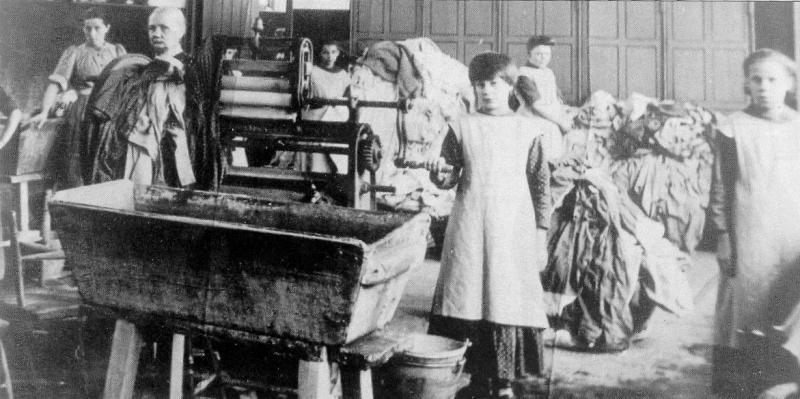
I came to this data sideways. Chasing my own family's history, I found my great-grandfather's household in the 1901 Census of Ireland, completed on Sunday, the 31st of March, 1901 — a carpenter living in Mallow with his wife, their infant son (my grandfather), and a servant girl from Limerick. His record is below, in his own hand.
◦ The record that started it · Census of Ireland, 1901
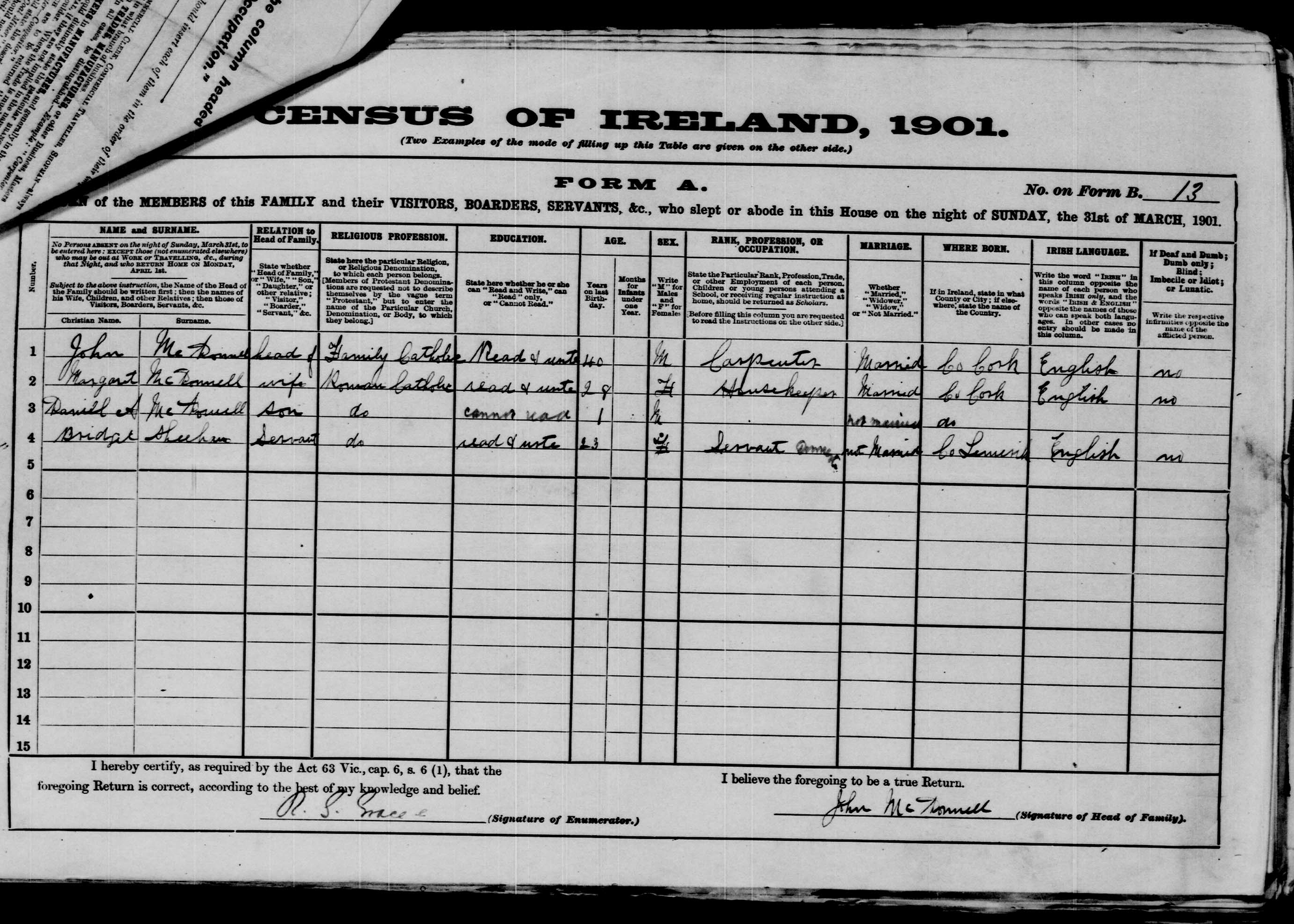
The McDonnell family return. John, 40, carpenter; his wife Margaret, 38; their son Daniel, aged 1 — my grandfather — and Bridget Sheehan, 23, a servant from Co. Limerick. John's signature certifies the return at the foot of the page.
That single page pulled me into the whole census — and raised a question. I scraped it at a particular moment in my own life, when I was somewhere between forty-five and fifty-five. So I went looking, in a sense, for my contemporaries across a hundred years: the 21,116 women of County Cork who were the age I was then. It is their lives this story is about.
These women shared a birth window of roughly 1846 to 1856. That is not a neutral fact. It means every one of them was an infant or a small child during An Gorta Mór, the Great Famine, which killed perhaps a million people and drove a million more to emigrate. They were the survivors of the catastrophe, now in middle age — and what follows is drawn entirely from how the census recorded them.
The 1901 census, for all its scope, tells us surprisingly little about each individual. Every household return captured only a handful of fields: name, age, relationship to the head of household, religion, occupation, birthplace, literacy, and — for the infirm — the nature of their disability. There is no record of income, of daily experience, of where a woman had lived before her marriage, or of children who had died. Each row is a silhouette: present, enumerated, but only partially seen.
04 — Two tongues, fadingIrish, English, and the cost of monolingualism
Cork sits in Munster, where the Irish language was in steep retreat by 1901. Where language was recorded, the great majority of these women spoke both Irish and English — the bilingual generation through which the language was, or was not, passed on.
The women who spoke only Irish were almost entirely shut out of literacy — because literacy meant English.
Cross the language field against literacy and a sharper, sadder pattern emerges. Schooling in 1901 Ireland was conducted in English. The women who had only Irish were, overwhelmingly, the women who could not read or write at all.
06 — The individuals behind the numbersOne woman in twenty-one thousand
Aggregates flatten people into proportions. But a census is made of individuals, and a few of them reach across the century and introduce themselves. Among all 21,116 women, exactly one gave her occupation as car owner — almost certainly the proprietor of a jaunting car, a horse-drawn cab. A widow, running her own small transport trade, and choosing to be recorded by her enterprise.
And around her, a vocabulary of women's work that has largely vanished from the modern world — trades the census recorded by the dozen that almost no one practises now. Hover each to see what it was.
These are the occupations time erased — cottage crafts, street trades and hand-work, almost all of it women's labour, much of it unpaid or barely paid.
◦ How this was made
The source is a transcription of 21,116 census returns — every woman aged 45–55 recorded in County Cork in the 1901 Census of Ireland. Like all hand-transcribed historical records, it is quite messy.
A single category hid behind dozens of spellings. "Cannot read," "cant read or write," "do not read and write" — all one thing. Religion appeared as Roman Catholic, R Catholic, R C, Rom Catholic and more. The analysis normalises these in Python (pandas) with rule-based consolidation, so the cleaning is reproducible and auditable, not a one-off. The charts are built in D3.js v7, with an interaction layer comprising of hover highlighting and tooltips.
Python / pandasD3.js v7data cleaningcrosstab analysisnarrative viz
On the structure of the returns, see B. Collins, "The Analysis of Census Returns: the 1901 Census of Ireland," Ulster Local Studies, vol. 15, no. 2.